Why Start Your Croatia Yacht Charter in Trogir?
Starting and ending your yacht charter in Trogir is one of the smartest and most convenient ways to explore the Dalmatian coast. Trogir is just 10 minutes from Split Airport and right next to Croatia’s top charter marinas, including ACI Marina and Marina Baotić.
While many itineraries start in Split, Trogir means shorter transfer times and faster embarkation, without giving up any of the route: Hvar, Korčula, Lastovo, Vis and Šolta are all reachable on the same loop, which is why this is one of the most popular round trips out of the Split area.
Trogir itself is also one of the most charming towns on the Adriatic, a UNESCO-listed old town of Romanesque and Renaissance architecture and cobbled alleyways. It’s worth a day of exploring before or after the charter, not just a place to board and leave.
The Daily Schedule
Yacht Charter Day 1 – Milna – The Bay of a Thousand Ships
Yacht Charter Day 2 – Hvar – Croatian L.A.
Yacht Charter Day 3 – Korcula – The Small Dubrovnik
Yacht Charter Day 4 – Lastovo The Best Stargazing Spot
Yacht Charter Day 5 – Vis The Mamma Mia Island
Yacht Charter Day 6 – Maslinica Quiet Settlement Under Pine Trees
Broker insight
A Trogir round trip is one of my favorite easy Croatia weeks. You start right by the airport, the hops are short, and you still hit the big islands without any one-way logistics to worry about.
 Daniel Asmus
Owner, Charter Broker, Active CYBA Member, IYBA, ECPY
Daniel Asmus
Owner, Charter Broker, Active CYBA Member, IYBA, ECPY
Day 1. Trogir or Split – Milna Brač

Brač is the first stop, the largest island on the Dalmatian coast and the source of the limestone that built Split’s Diocletian Palace. By some accounts, part of the White House in Washington was built from it too. The vineyards and olive groves make the short crossing from Trogir worth taking slowly rather than rushing straight through.
The overnight is Milna, on Brač’s west coast, tucked into a bay deep enough to form one of the most sheltered natural harbours on the island. ACI Marina covers the practical side of things; the Village Port is the more local option if you’d rather tie up among the fishing boats. Bobovišća, the neighbouring bay, is worth the short detour by tender for a quieter anchorage instead.
An evening walk through Milna is worth the time: stone architecture, street musicians playing outside the baroque church, and a slower pace than some of the islands still ahead this week.
Day 2. Milna Brač – Hvar (Palmižana)


Hvar has a reputation as Croatia’s answer to L.A., the island that draws the crowds, the yachts, and occasionally a film crew, ever since Orson Welles spent several weeks in Hvar Town in 1967 filming The Deep.
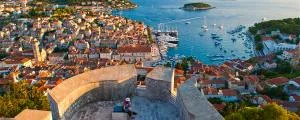
Hvar Town’s biggest draw is the fortress looming above it, but most of its historical buildings sit right around the main square, the largest in Dalmatia and a genuinely good place to stop for a coffee, with a setting that rivals Venice.
For those staying overnight in Hvar, Hula-hula Beach Bar in the neighbouring bay is a 15-minute walk and stays lively into the night. For a quieter overnight, the Pakleni Islands archipelago just offshore has plenty of secluded anchorages; the crew will find the right spot to chill.
ACI Marina Palmižana, on the island of Saint Klement, is worth the stop in its own right: a pine-forest bay with a footpath across to Vinogradišće on the southern side, where the water turns clear turquoise and the restaurants sit right among the trees. Laganini is our pick, and U2’s Bono has praised it too, for what that’s worth.
For those who want to party, Carpe Diem Beach on Stipanska Island runs a Full Moon party that’s become something of an institution.
Day 3. Hvar, Korčula (Badija)


Ščedro sits between Hvar and Korčula, a near-uninhabited island worth the stop for a swim in clear water and lunch at Restaurant Kod Ive, built right onto the beach beside the ruin of a 16th-century Dominican monastery.
From there it’s worth deciding early: stay the night at anchor off Ščedro, or push on the 22 nautical miles east to ACI Korčula. The channel between the Pelješac peninsula and Korčula’s northeast tip carries a steady northwest wind known locally as the Maestral, and it’s a regular spot for windsurfers and kiteboarders on the way through.
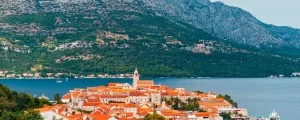
Korčula Town, nicknamed “small Dubrovnik,” sits on an oval peninsula ringed by its own medieval walls. Once moored at ACI, the old town’s stone streets, galleries and jewellery shops are an easy walk from the marina.
Day 4. Korčula – Lastovo


Badija Island, next to Korčula and home to a 15th-century monastery, is worth a swim stop before heading south.
Lastovo is a 20-nautical-mile cruise on, one of the remotest islands in the Adriatic and known for its 15th- and 16th-century Venetian architecture. We recommend the naturally protected bay of Zaklopatica on the island’s north side: every restaurant here offers free moorings, and Augusta Insula is the standout, cooking with produce from their own garden. Their lobster buzara is the dish to order.
Zaklopatica is a 30-minute walk from Lastovo town, and with almost no light pollution this far from the mainland, it’s one of the best stops on the whole route for stargazing.
For a different overnight, Porto Rosso in the hidden bay of Skrivena Luka on the island’s south side looks straight out toward Italy. Order the lobster pasta.
Day 5. Lastovo – Vis

Vis splits into two very different stops. Komiža, on the south side facing Italy, is a fishing settlement sheltered by a long dock and a genuinely good refuge from the Bora wind. It’s worth arriving before noon if bad weather tends to build later in the day. Vis Town, on the northeast side, is the more polished option, with stone buildings dating back to 400 BC and a distinctly Italian feel.
After four days on the water, day 5 is a good one to spend more time ashore. A military tour of Vis covers the island’s Cold War-era catacombs and bunkers, and runs from both Komiža and Vis Town. Ask the guide to point you toward a restaurant serving peka, the Dalmatian dish of meat or octopus and vegetables slow-cooked under a bell. Roki’s is the one our brokers keep recommending, both for the peka and for wine from their own organic vineyard.
Day 6. Vis – Šolta

Day 6 turns back toward the mainland by way of Šolta, the island passed on day 1 heading out to Milna. The northwest end has the better options for a last night out.
Šešula Bay is the pick for anchoring: a pine-lined bay with a handful of restaurants reachable by dinghy or mooring buoy. Maslinica, a 10-minute walk away, has a modern marina sheltered from all winds and Martinis Marchi, a restaurant inside a genuine mansion with one of the better dinner views on the route. The village itself has its own restaurants and bars if a mansion dinner isn’t the mood, and the sunset from the marina dock is worth timing dinner around.
Day 7. Šolta – Trogir

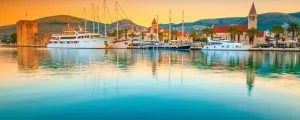
Trogir is a 7-nautical-mile hop from Maslinica back to the marinas where the week started. Nicknamed the Little Venice of Dalmatia, its medieval core is a UNESCO World Heritage Site and small enough to explore properly on the last morning before hand-back.
The Cathedral of St Lawrence, mixing Romanesque, Gothic and Renaissance work, sits at the centre of town, and Kamerlengo Castle on the edge of the old core gives a proper view back over Trogir and the Adriatic. Depending on when you’re in port, the town also runs a steady calendar of music festivals and art exhibitions worth checking before you leave.




 iMessage
 WhatsApp